
The Mission is Multiplayer
Why multiplayer AI is the capability that makes artificial intelligence operational in national security.

01 // Nine days in
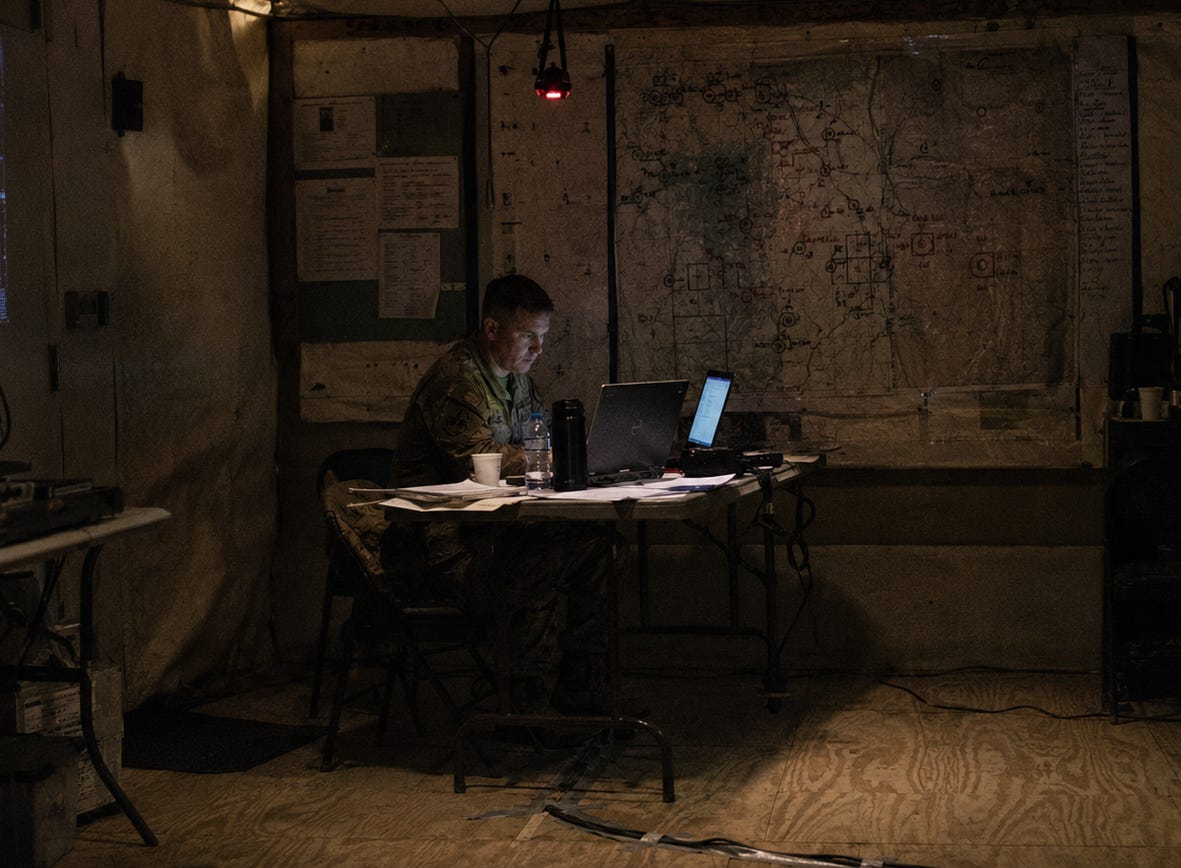
It is a few minutes past three in the morning, nine days into a crisis planning effort, and a Major on the future operations staff has just found the problem. The sustainment annex was written against a scheme of maneuver that changed on day three. Its movement tables commit a transportation battalion the base order sent elsewhere five revisions ago. The orders brief is at 0800, and the fix will ripple through four other annexes before anyone sleeps.
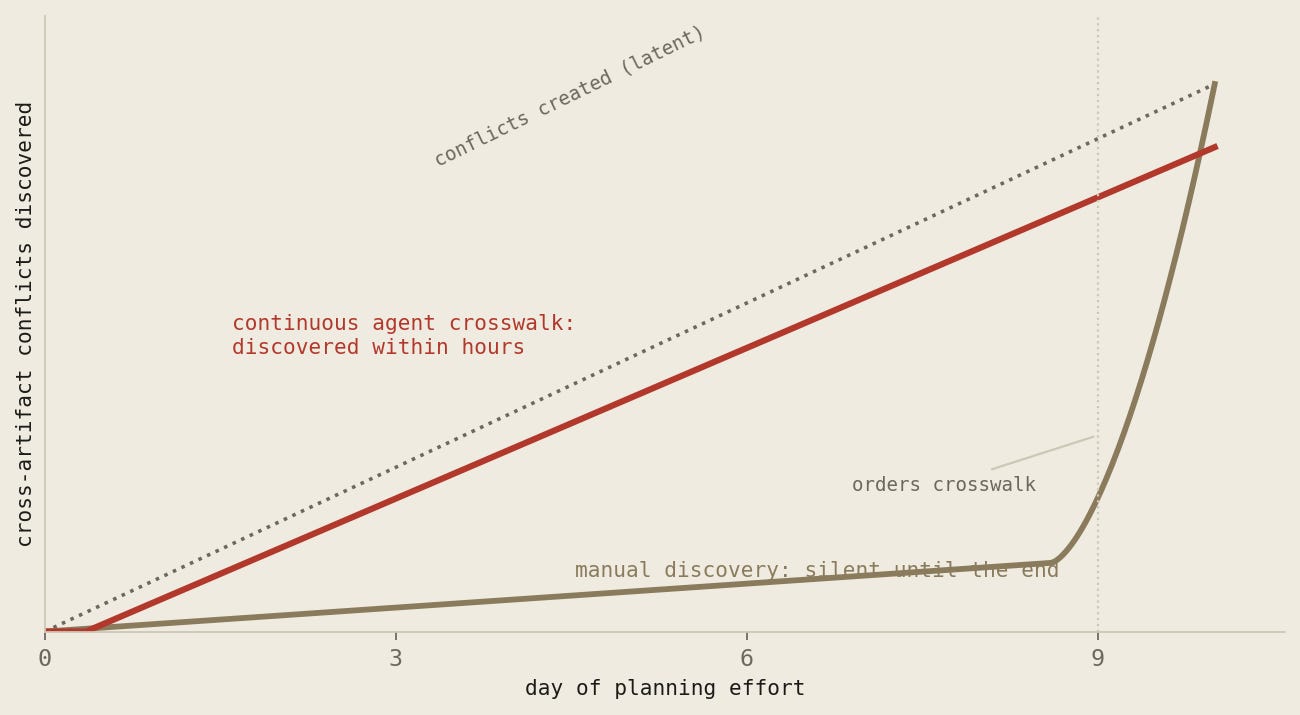
No one on this staff did anything wrong. Every cell produced its piece on time. Coordination happened through email and Sharepoint, and the orders crosswalk caught the contradiction at the end, when contradictions are most expensive to fix.
This is a well-equipped staff. Every officer in the building has a generative AI assistant, and most of them used it. The annex that failed was itself partly AI-drafted, and it was a good annex for the plan that existed on day three. The failure did not occur inside anyone’s chat session. It occurred between them.
Some version of that scene is playing out across the national security enterprise right now. Generative AI is deployed at scale in unclassified and NIPR environments, with subsets having access on SIPR and other sensitive networks. The adoption is growing and the individual gains are real. However, the organizational work looks almost exactly the way it looked in 2019. The logistics rollup is still a staff officer copying numbers from twelve subordinate reports into one slide at 0400, and the intelligence summary still takes a shift to produce.
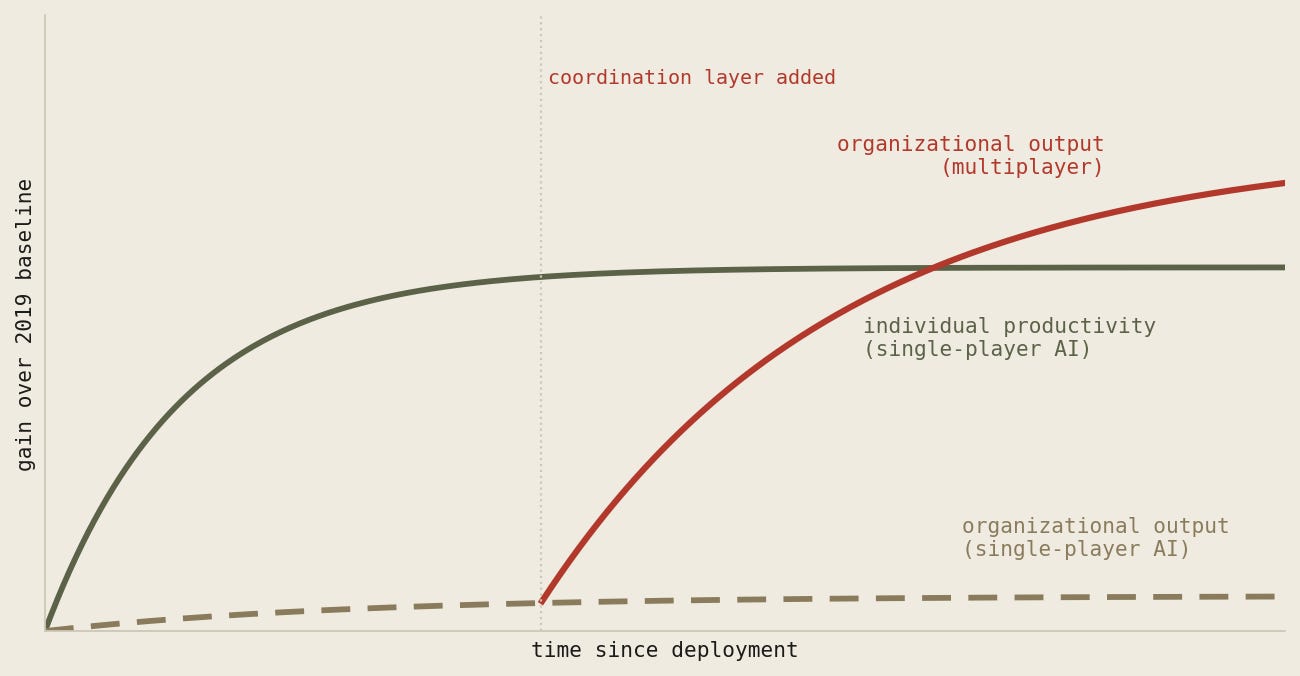
Operations research has held to one finding for eighty years: military effectiveness lives in the coordination layer, and individual performance matters far less than how the pieces fit. Generative AI has been optimized for the wrong layer. The enterprise bought tools for individuals and fielded them into organizations whose entire function is collective work. The Major at 0300 did not need a better drafting assistant. The staff needed the contradiction caught on day three.
That is the gap multiplayer AI closes.
02 // The ceiling is structural - where single-player AI stalls
The dominant interaction model for AI today is a private conversation. One person and one model. Everything of value in the exchange lives inside a session no one else can see.
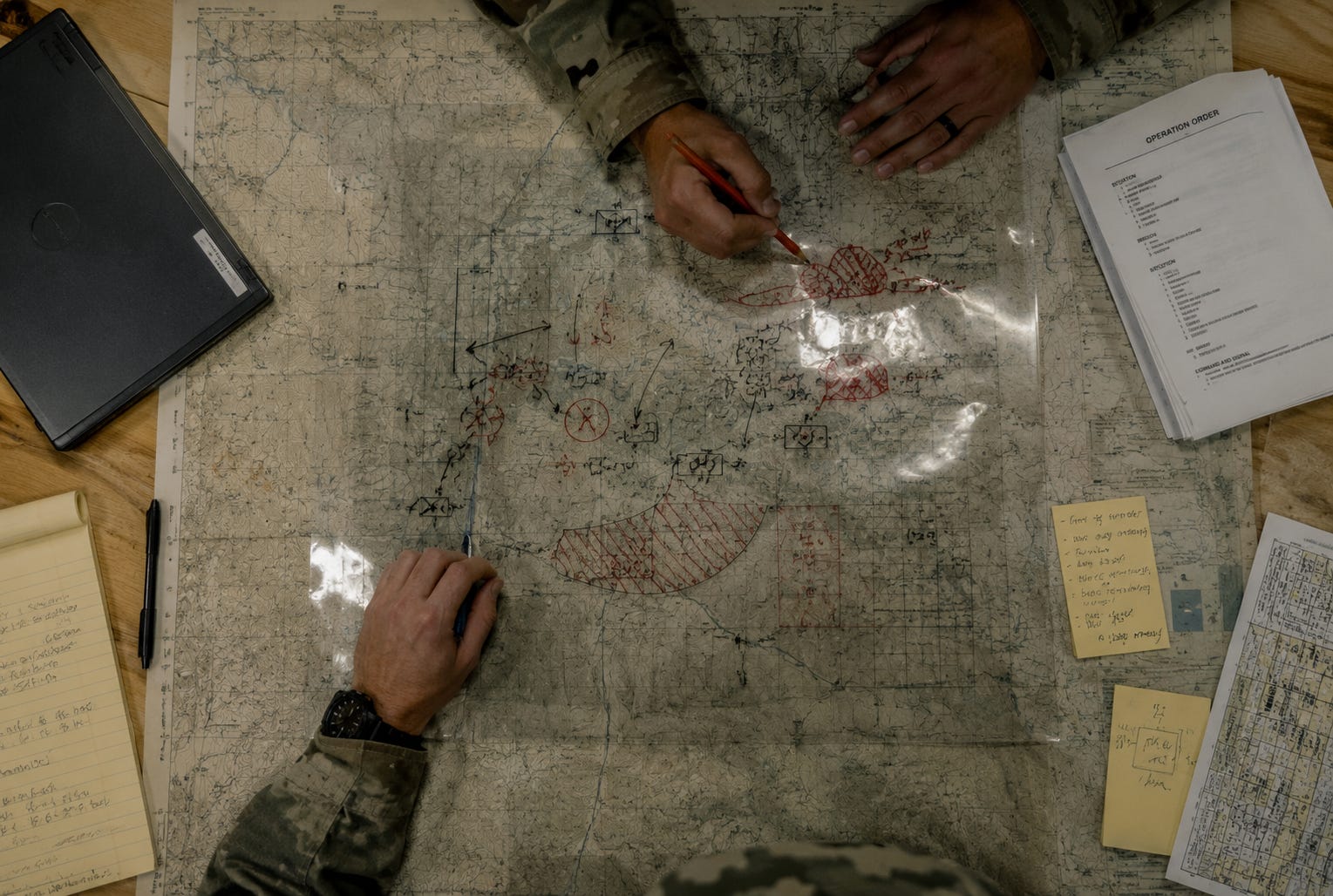
That model has a structural ceiling in military organizations. A plans officer drafts an appendix. It goes to the chief of plans, then to the fires and sustainment cells, because the appendix makes assumptions about both. It comes back with conflicts someone must reconcile. The revised draft goes into the crosswalk against the base order and every other annex. It gets briefed, changed again, and approved, and at that moment the document acquires legal and moral weight: it directs people to do dangerous things, and a specific human being is accountable for its contents.
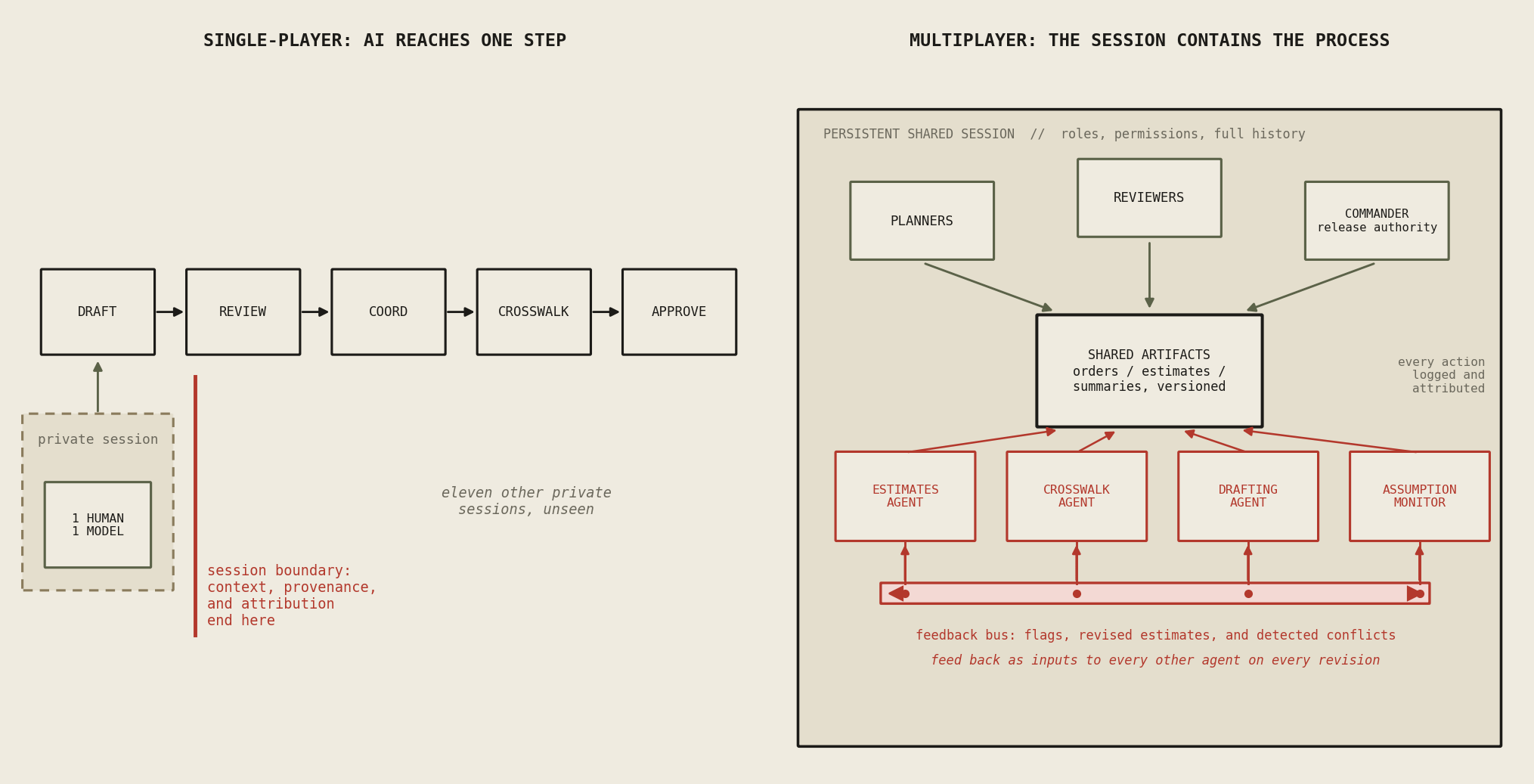
A private AI chat reaches one step of that process. The plans officer produces a better first draft, faster. That is where adoption sits today. The moment the draft leaves the session, the AI is out of the loop. It cannot see the fires cell’s objection or the Tuesday change to the sustainment assumption. It cannot check the appendix against the base order, which lives in another system, or against the annexes in eleven other people’s private sessions. When the crosswalk finds a contradiction, no one can say where the bad assumption entered.
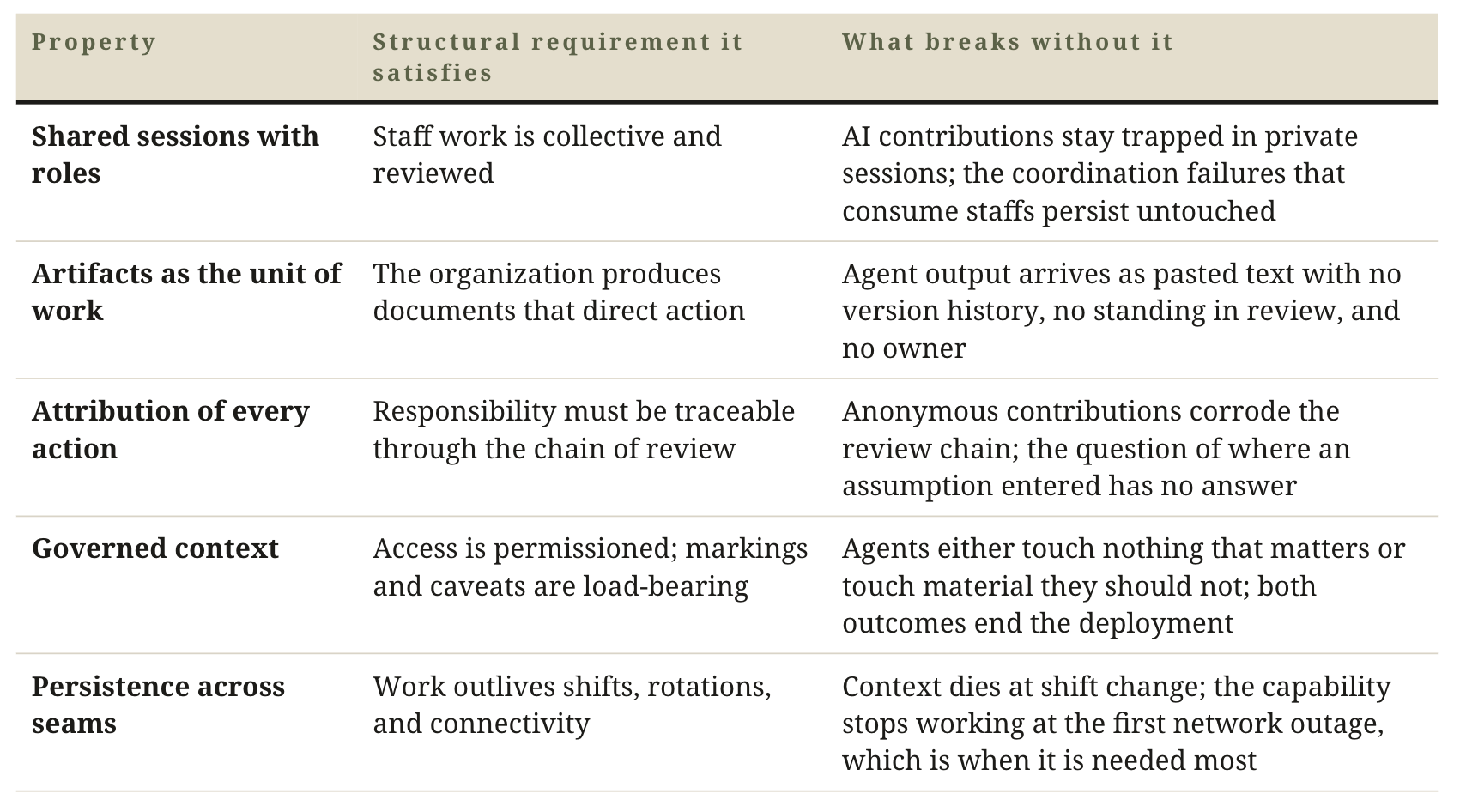
Four properties of military work break the single-player model. The unit of work is the shared artifact. Orders, estimates, overlays, and matrices, built by many hands over many iterations. The work carries attribution, because responsibility must be traceable through a chain of review. The work outlives any individual’s attention, because battle rhythm runs in shifts and personnel rotate on cycles that bleed institutional knowledge. And the context is governed, because who may see which source at which classification is load-bearing. None of these is a technology preference. They are what command authority looks like when it is implemented as an organization.
03 // What multiplayer actually means
The commercial market began using the word this year, mostly for a shared assistant in a chat channel. For national security work it means five things. Humans and agents operate in one persistent workspace with roles, and the session survives its participants, so a planner who joins on day four inherits the full context of the days before. Agents produce editable, versioned artifacts subject to the same review as a human draft. Every agent action is logged, attributed, and inspectable. The material an agent may use is scoped by permission, and provenance travels with it, so citations resolve to sources and markings propagate. Sessions and artifacts survive shift changes, turnover, and network partitions, which means the capability has to run at the edge. A channel assistant has the first property, partially. Operational multiplayer requires all five.
04 // Planning - the first and deepest fit for multiplayer AI
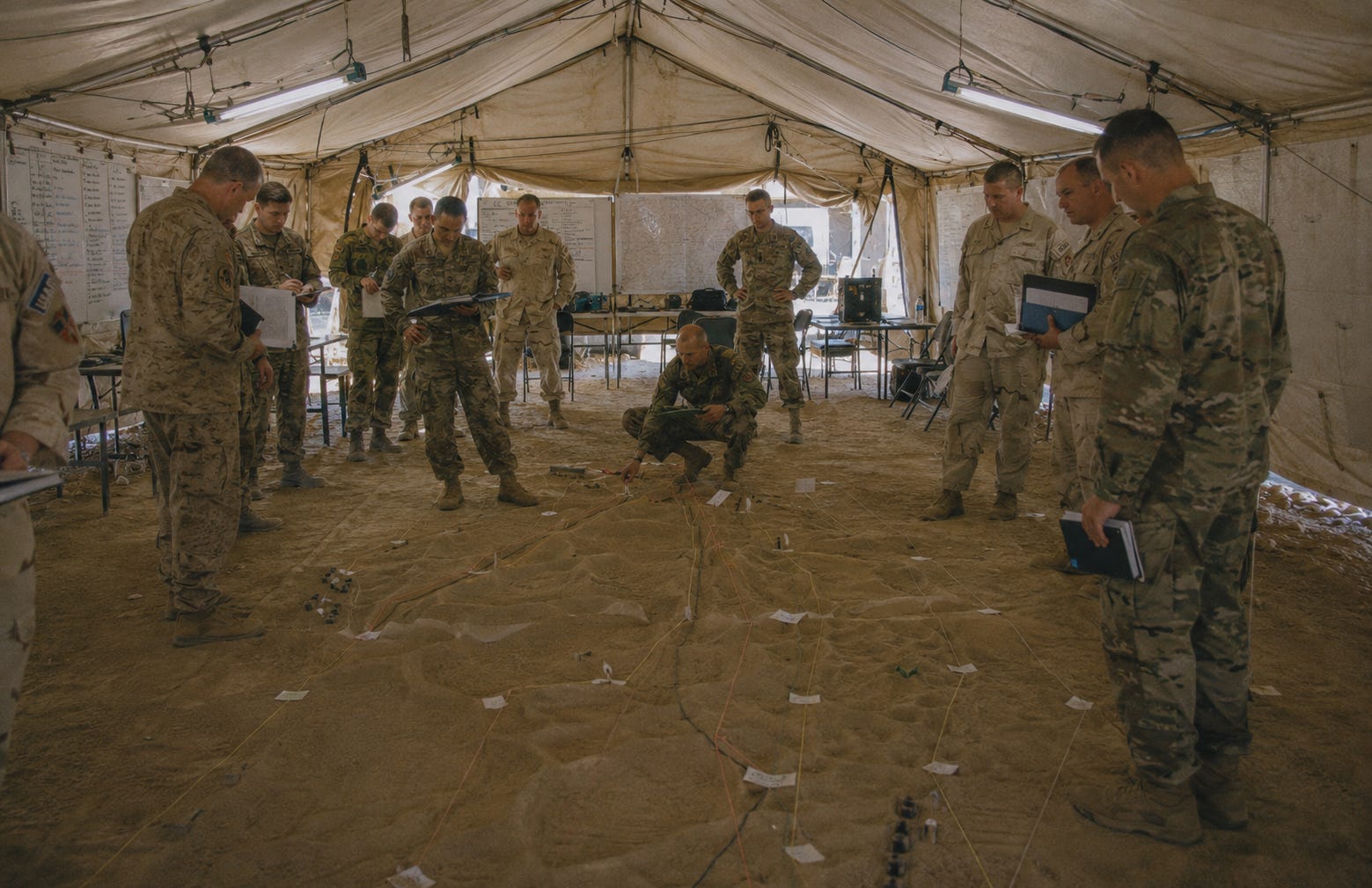
Military planning is the human activity most precisely shaped to the multiplayer pattern. A planning team is a temporary organization of specialists, each maintaining a running estimate of one domain. Mission analysis feeds course-of-action development, courses of action get wargamed, the survivor becomes an order with a base document and a dozen annexes, each owned by a different section, all of which must agree.
That last clause is where planning efforts go to die. Doctrine requires every section to maintain a running estimate. In practice estimates go stale within days, because the people who own them are consumed producing the artifacts in front of them. Doctrine requires a crosswalk before publication. In practice it happens at the end, under the worst time pressure, and catches perhaps half the contradictions. Army planning guidance assigns roughly 30 percent of staff effort to orders production and another 35 percent to course-of-action analysis [10]. The mechanical phases dominate the clock. Army Research Institute analysis found staffs deficient in synchronizing the plan [11], and the Army’s 2023 planning handbook exists to reverse decision-making trends observed for years at the combat training centers [12]. Twenty-five years separate those documents and they describe the same problem.
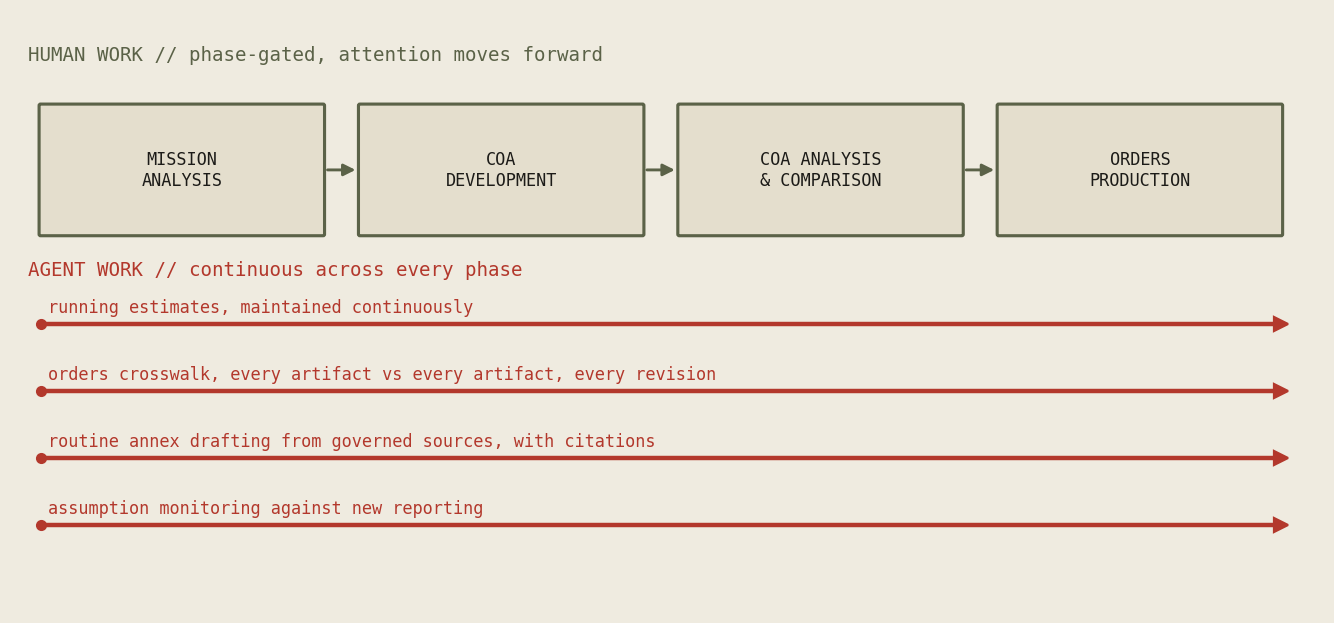
The same team, with agents in the session, works differently. One agent maintains the running estimates continuously, because it never has to choose between the estimate and the annex in front of it. Another runs a continuous crosswalk, flagging the contradiction between the fires appendix and the airspace annex within minutes. A third drafts the routine annexes from the base order with citations, for planners to revise. A fourth flags when new reporting undermines an assumption logged on day one. Humans still make every decision that matters: the commander's intent, the course-of-action selection, the acceptance of risk, the signature on the order. In exercise conditions, Legion has measured order-of-magnitude reductions in the time to produce staff products of this kind.
Plans decay. Their value is the shared understanding they build, and it starts rotting the moment the team disperses. A multiplayer session does not disperse. The plan, its assumptions, its citations, and its revision history persist. When the branch plan activates, the new team, or the old team three rotations later, inherits the reasoning instead of the PDF. RAND found that 40 to 50 percent of soldiers in deploying units had been in the unit less than a year [16]. For an enterprise with that turnover, persistent planning context may be the most valuable database it has never had. Crisis action planning removes the slack. The organizations that can run the cycle with agents carrying the consistency load will operate inside decision cycles manual staffs cannot match.
05 // Current operations - The watch floor was always multiplayer
A joint operations center has been running multiplayer for decades with humans only. A watch floor is a persistent shared session with roles, a battle rhythm, a common operational picture, and a set of recurring artifacts: the intelligence summary and the significant activities log.
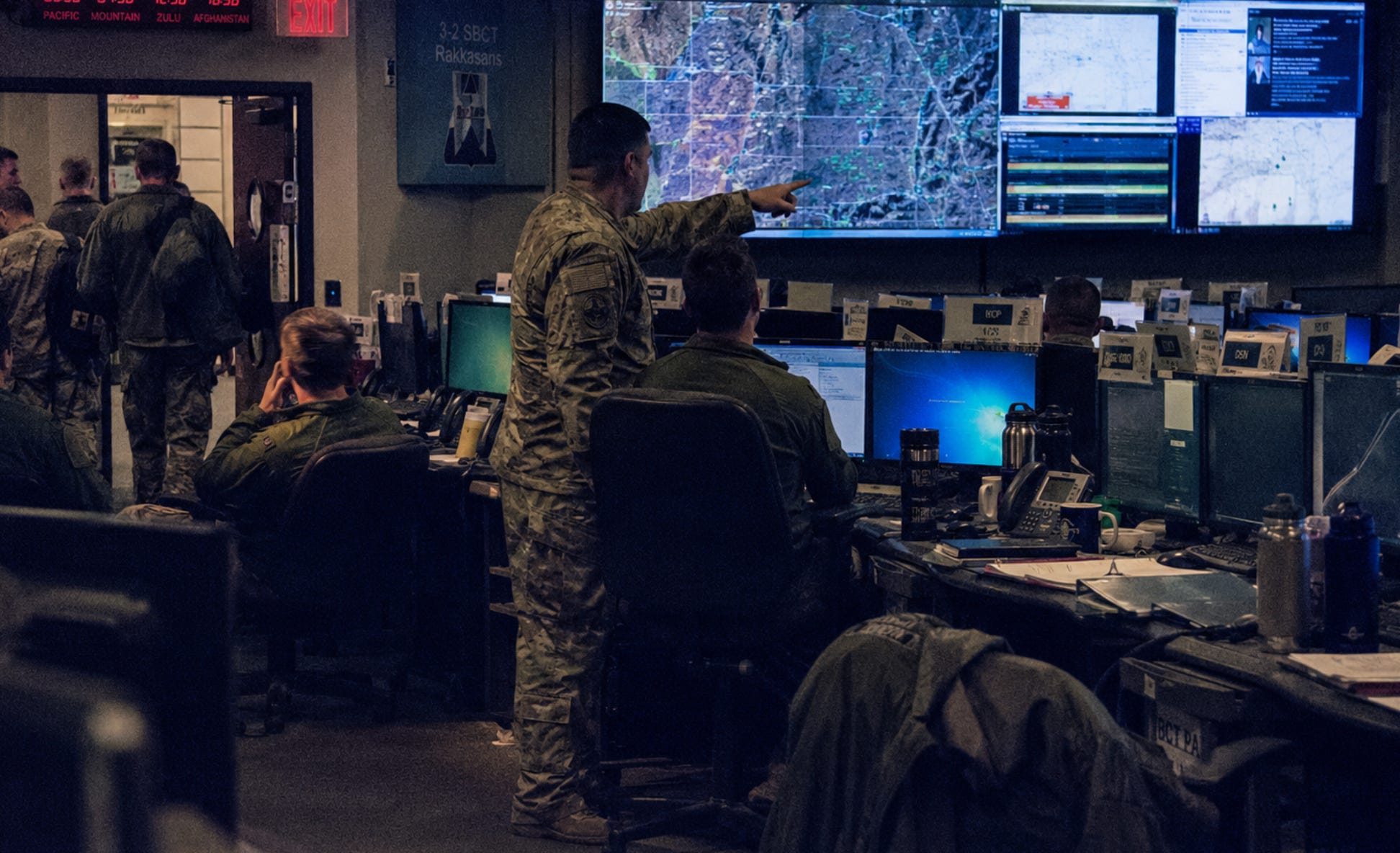
It has a famous failure mode at the seams. The most dangerous hour on a watch floor is the hour after shift change. The outgoing crew compresses twelve hours of context into a pass-down brief, and whatever did not make it in is gone. The intelligence summary consumes an analyst’s entire shift, spent producing the record of the shift rather than analyzing it.
An agent present for the full rotation does not need the pass-down. It carries the context across the boundary and answers the incoming battle captain’s questions about anything in the last three weeks, with citations to the source traffic. The summary becomes a draft the agent produces continuously and an analyst reviews.
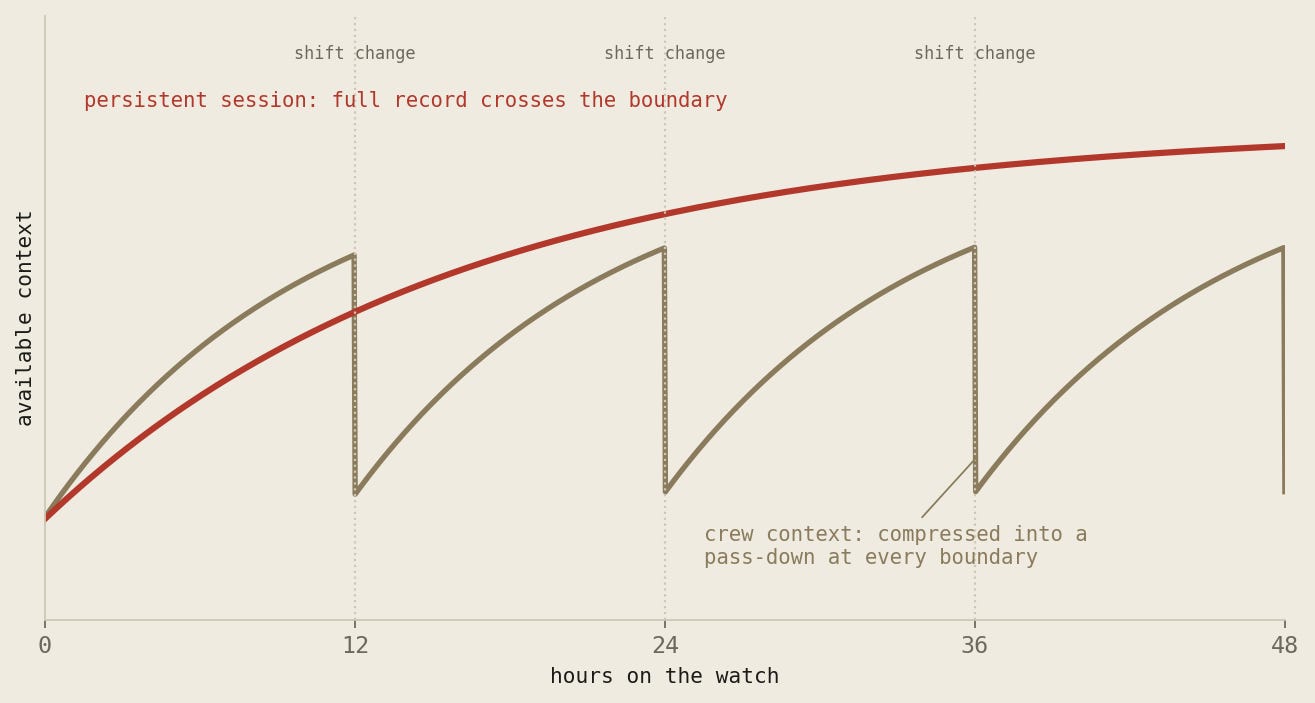
The cost of the seams has been measured elsewhere. The I-PASS study, across 10,740 admissions in nine hospitals, found that standardizing the handoff alone cut medical errors by 23 percent [1]. The 1988 Piper Alpha explosion, 167 dead, began with a safety valve whose removal was recorded on paper but never conveyed at shift handover [4]. The record existed. It did not move with the work.
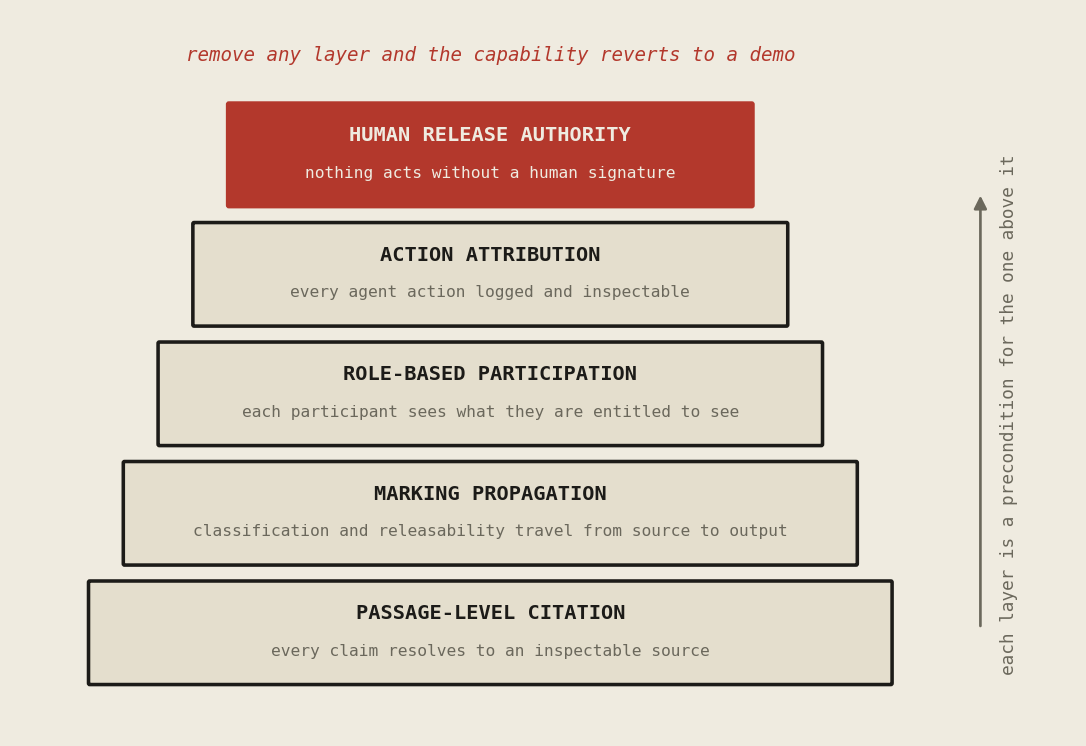
Attribution binds hardest here. Products from the watch floor move forces and, in some formations, feed targeting. An unattributed AI contribution in that chain is unacceptable, and everyone who has worked in one of these buildings knows it. The gap between a helpful summary in a channel and a product a battle captain will sign is the governance stack: source citation down to the passage, markings that propagate, action logs, and human release authority.
06 // Sustainment - Shared state is the whole game
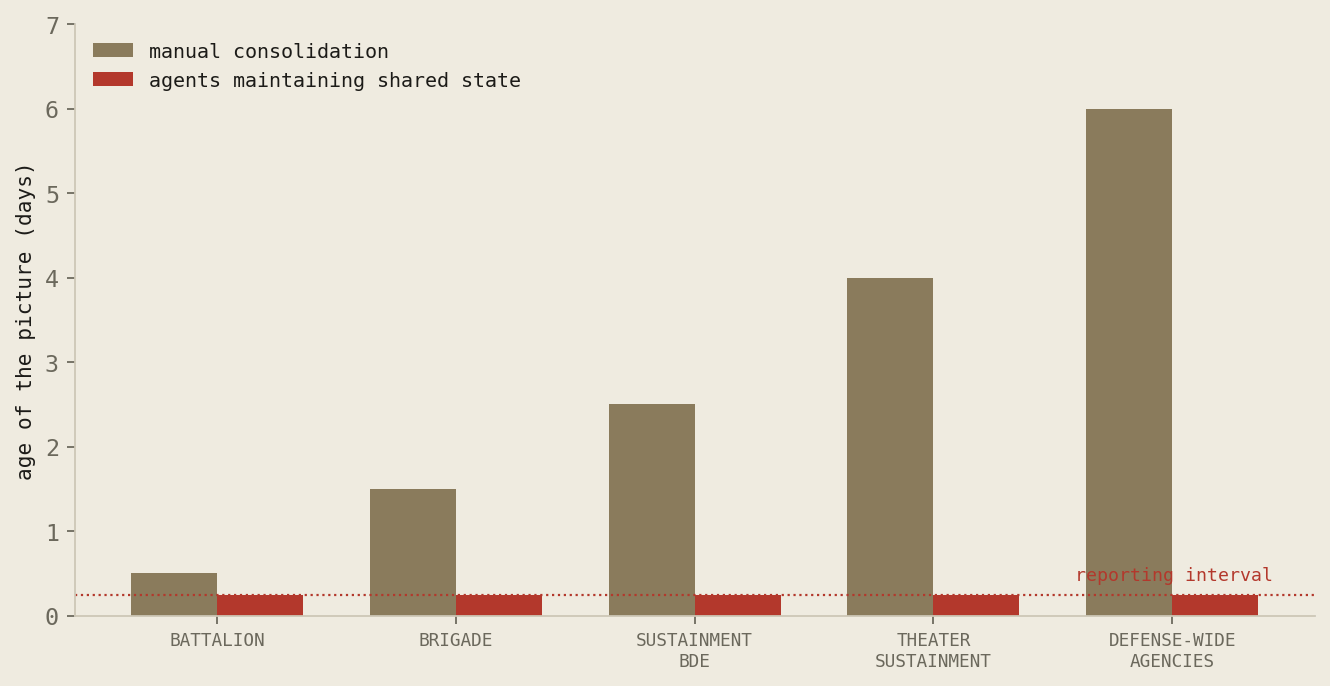
Sustainment is the least discussed of the three functions and may prove the largest, because the coordination burden is heaviest and the data most fragmented. A battalion reports supply status to brigade, brigade rolls up its battalions to the sustainment brigade, and the rollup continues through the theater sustainment command to the defense-wide agencies. At every echelon a human reads the reports from below, reconciles their inconsistencies, and produces a new report for the level above. The picture the senior commander sees is days old by the time it reaches the slide, and everyone in the chain knows it.
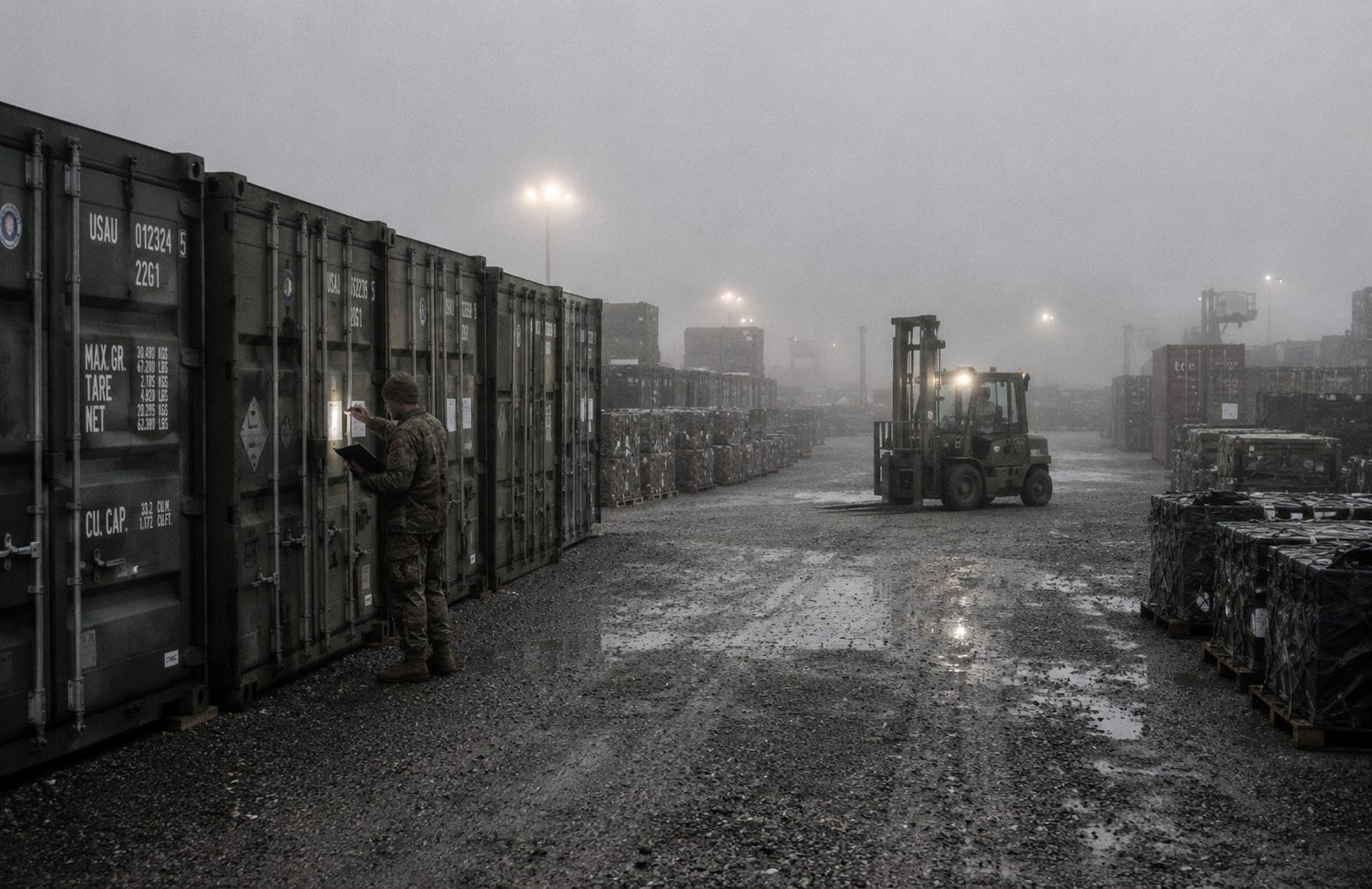
The operations research community has built optimization models for these problems for seventy years, and they mostly work. What defeats them is that the state they optimize over is stale and fragmented. The shared state does not exist as shared state. It exists as thousands of documents describing state at different times, reconciled by hand. GAO found the Army lost visibility over equipment and supplies during the Desert Storm buildup, often not knowing a container’s contents until it was opened [6][7]. A decade later GAO found the same problems in Iraq [8]. The data existed at the collection points. No layer held it as one picture.
There is a precedent for fixing the coordination layer itself. In 1995 the Army, with RAND’s Arroyo Center, launched Velocity Management against order-and-ship times that ran over 22 days. It bought no trucks and built no depots. It measured the process end to end and re-engineered the segments across the organizational boundaries that had confined every prior attempt, and within a few years order-and-ship times fell by roughly two thirds nationwide [13]. It ran on periodic human measurement and episodic campaigns. Agents maintaining shared state perform the same function continuously, on every requisition.
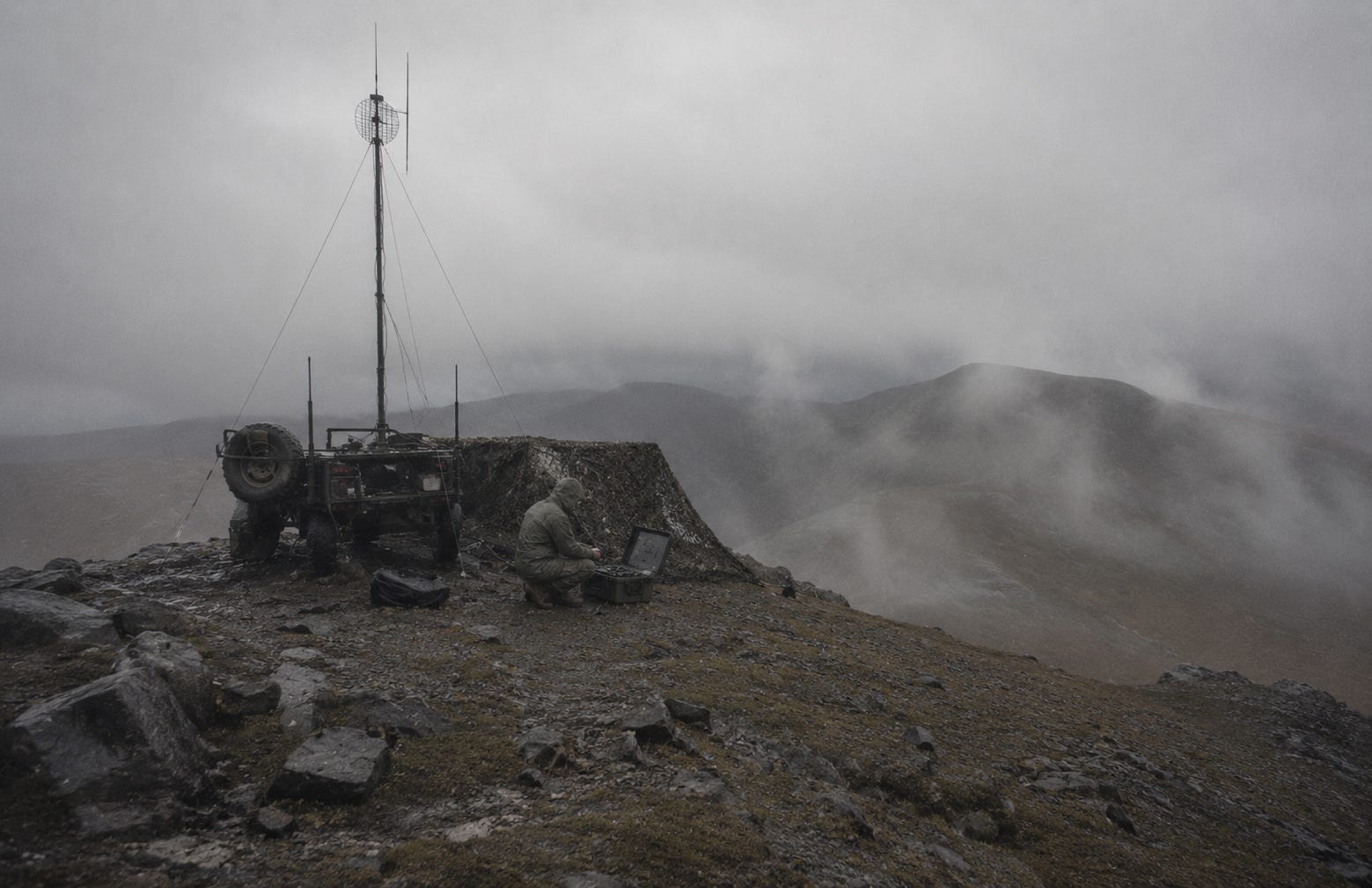
Two features of the coming environment make efficiency the lesser concern. Distribution networks in a Pacific fight will be attacked, and the tempo of re-planning around losses will exceed what manual coordination can sustain. RAND’s analysis for Army Pacific concludes that under direct disruption and a surge in demand, existing sustainment plans are likely to break down [15]. And sustainment nodes will operate for long periods without reachback. A multiplayer session that requires a cloud connection is a garrison capability. The sessions, agents, artifacts, and governed context have to run forward on local compute and reconcile when the network returns.
Two features of the coming operating environment make efficiency a lesser concern. The first is contested logistics. Planning assumptions built over twenty years of uncontested movement do not survive a peer fight in the Pacific, where distribution networks will be attacked, and where the tempo of re-planning around losses will exceed what manual coordination can sustain. RAND’s analysis for Army Pacific reaches the same conclusion in plainer terms: under direct disruption and a surge in demand, existing sustainment plans are likely to break down, and decades of just-in-time practice have produced a system that is efficient but brittle [15]. The second is disconnection. Sustainment nodes in that fight will operate for extended periods without reachback. A multiplayer session that requires a cloud connection is a garrison capability. The sessions, the agents, the artifacts, and the governed context have to run forward on local compute and reconcile when the network returns. That is the baseline condition of the environment the force has been told to prepare for, and it is why edge execution belongs inside the definition of multiplayer instead of in an appendix.
07 // Mechanism - How the processes change & where the benefit lands
The staff process itself does not change; doctrine survives contact with this technology. What changes is which parts of it consume human hours. Agents absorb the work that is continuous and cross-referential: maintaining estimates, reconciling artifacts, rolling up reports, drafting from governed sources. Humans keep the judgment.
No study yet measures multiplayer AI inside a military staff, but the adjacent evidence is consistent. In high-consequence domains built on shift work, how well a team holds a shared model of its situation is among the stronger predictors of its performance [9], and RAND’s assessment of machine learning for Air Force command and control names decision speed and more efficient use of human capital as the principal gains [14].
The benefit accrues in two forms. The first is recovered time, easy to count: staff hours returned from transcription to analysis. The second is error economics, harder to count and worth more. A contradiction caught on day three costs a revision. Caught on day nine it costs a night, a ripple through four annexes, and sometimes the credibility of the plan. Moving discovery earlier is invisible in any metric that only counts speed. The recovered hours only convert to output if commanders restructure the battle rhythm around them, and the error-economics benefit depends on trust in the flags, which is why the governance stack is a precondition for the benefits, not a compliance cost added to them.
08 // Requirements - What the capability demands
The word multiplayer is about to be applied to many products that do not meet the requirement. Governance comes first: passage-level citation, marking propagation, role-based participation, complete action attribution. In most software markets these are enterprise features added late. In this market they are product-market fit. An organization that cannot audit the AI's participation in its work will not, and should not, let it participate.
Persistence comes next. Sessions have to outlive their participants and the network, which means local execution, compute scheduling, mesh operation among disconnected nodes, and reconciliation on reconnect. None of it is optional if the target is the force rather than its headquarters.
The organizational requirements take longest. Staffs will need conventions for who may task an agent, what its draft is worth in the review chain, how its flag is adjudicated when it contradicts a section chief, and when it must stop and wait for a human. Doctrine will lag. The formations that build these conventions first, in exercises, hold an advantage that has nothing to do with whose model sits underneath. The durable capability is the operating layer and the practices around it. The models beneath should be swappable.
08 // Closing - The question this forces
A single-player technology was deployed into an organization built entirely around collective work, and the organizational output barely moved. The fix is visible now, and the early evidence from exercises says the gains are not incremental.
Multiplayer AI forces a question that single-player AI let everyone defer. A private assistant is easy to govern because its output has no standing until a human adopts it. An agent that drafts the annex, maintains the estimate, flags the contradiction, and briefs the incoming watch is a participant in staff work, and participants sit inside a chain of accountability. When an agent’s contribution shapes a plan that goes wrong, the answer cannot be the vendor’s terms of service. Attribution logs and human release authority are the technical foundation for that answer. They are not the whole answer.
The institutions that engage the question early, with real staffs producing real products under governance built for the purpose, will define the conventions everyone else inherits. The ones that wait for the doctrine to arrive will find it was written by whoever showed up first.
References
[1] Starmer, A.J., et al. “Changes in Medical Errors after Implementation of a Handoff Program.” New England Journal of Medicine 371 (2014): 1803 to 1812.
[2] The Joint Commission. Sentinel Event Alert, Issue 58: Inadequate Hand-off Communication. 2017.
[3] CRICO Strategies. Malpractice Risks in Communication Failures: 2015 Annual Benchmarking Report. Risk Management Foundation of the Harvard Medical Institutions, 2015.
[4] Cullen, The Hon. Lord. The Public Inquiry into the Piper Alpha Disaster. London: HMSO, 1990.
[5] Cooper, G.E., M.D. White, and J.K. Lauber, eds. Resource Management on the Flightdeck. NASA Conference Publication 2120, 1980; Billings and Reynard, ASRS analyses, 1981.
[6] U.S. General Accounting Office. Operation Desert Storm: Transportation and Distribution of Equipment and Supplies in Southwest Asia. GAO/NSIAD-92-20, 1991.
[7] U.S. General Accounting Office. Operation Desert Storm: Lack of Accountability Over Materiel During Redeployment. GAO/NSIAD-92-258, 1992.
[8] U.S. General Accounting Office. Defense Logistics: Preliminary Observations on Logistics Activities During Operation Iraqi Freedom. GAO-04-305R, 2003.
[9] DeChurch, L.A., and J.R. Mesmer-Magnus. “The Cognitive Underpinnings of Team Effectiveness: A Meta-Analysis.” Journal of Applied Psychology 95 (2010): 32 to 53; Niler et al., 2021.
[10] Headquarters, Department of the Army. FM 5-0, Planning and Orders Production, 2022, and predecessor planning doctrine.
[11] U.S. Army Research Institute. The Military Decision-Making Process (MDMP). Research Product 98-33, 1998.
[12] Center for Army Lessons Learned. Military Decision-Making Process: Organizing and Conducting Planning Handbook, 2023.
[13] Dumond, John, Rick Eden, et al. Velocity Management. RAND Corporation, DB-126-1, 1995; Accelerated Logistics, MR-1140-A, 2000.
[14] Walsh, Matthew, Lance Menthe, Edward Geist, et al. Machine Learning-Assisted Command and Control, Vol. 1. RAND Corporation, RR-A263-1, 2021.
[15] Mazarr, Michael J., Duncan Long, et al. Sustaining U.S. Army Operations in the Indo-Pacific. RAND Corporation, RR-A2434-3, 2025.
[16] Lippiatt, Thomas F., and J. Michael Polich. Reserve Component Unit Stability. RAND Corporation, MG-954-OSD, 2010.
This is exactly right.